


A spoliation-of-evidence claim can reshape a trucking accident lawsuit before the first deposition is ever scheduled. When opposing counsel argues that your company failed to preserve critical records, courts may impose sanctions that give jurors permission to assume the missing evidence was harmful to your defense. For Texas trucking companies, few procedural threats carry more weight than this one, and knowing how to respond is not optional.
At Fahl & Donaldson, we defend trucking companies, carriers, and insurers across Houston and throughout Texas. When a spoliation claim enters a case, our team assesses what evidence exists, what preservation obligations applied, and how to challenge the motion on both factual and legal grounds. If your business is facing this issue, trucking accident defense demands a strategy that treats evidence questions as seriously as liability questions.
What Does a Spoliation Claim Allege?
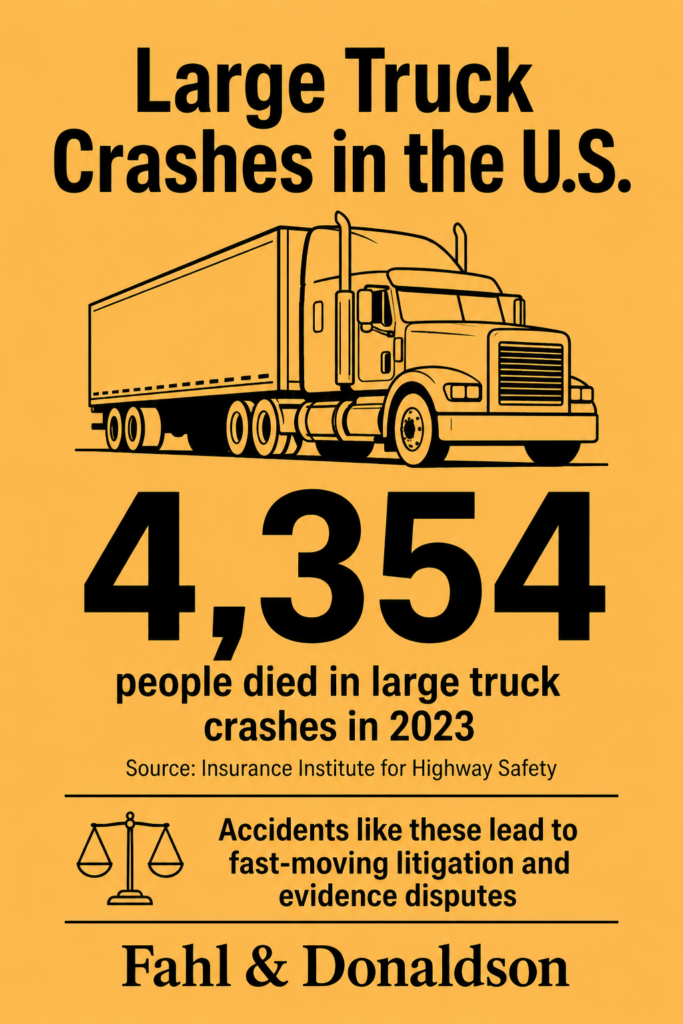
Spoliation occurs when one party alleges that another destroyed, altered, or failed to preserve evidence relevant to anticipated litigation. In trucking cases, the records most frequently at issue include electronic logging device data, dashcam footage, driver qualification files, maintenance and inspection logs, and black box data from the vehicle’s engine control module. According to the Insurance Institute for Highway Safety, 4,354 people died in large truck crashes in 2023, which reflects just how frequently these accidents lead to litigation and how quickly evidence questions arise.
Texas courts require that a legal duty to preserve evidence exists before any spoliation finding can be made. That duty typically attaches when litigation is “reasonably anticipated,” meaning the company knew or should have known a lawsuit was coming. Courts look at the severity of the accident, whether injuries were reported, and whether any legal notices were received. If records were deleted, overwritten, or not retained after that duty was attached, sanctions ranging from adverse jury instructions to case-dispositive rulings become possible.
How Should Trucking Companies Respond?
Responding to a spoliation motion requires a factual and procedural defense built around demonstrating that missing evidence was not the product of bad faith and that no preservation duty had attached when the records were lost. Several strategies form the core of an effective response.
Here are the primary defense arguments available to trucking companies facing this type of motion:
- Documented retention policy: Show that deletions followed a consistent, written records retention policy applied in the ordinary course of business, before any litigation was foreseeable.
- Clear timeline: Establish exactly when the accident occurred, when legal action became reasonably anticipated, and what preservation steps were taken and when.
- Contested duty trigger: Challenge whether litigation was truly foreseeable at the time the evidence was lost, particularly when injuries appeared minor or no demand letter was sent promptly.
- Lack of prejudice: Argue that the missing records would not have changed the outcome and that the opposing party has not been materially harmed by their absence.
- Substitute evidence: Identify equivalent information available through other sources, such as witness statements, third-party records, or documentation that covers the same factual ground.
A strong response depends on organized internal recordkeeping and legal counsel that can move quickly once an accident occurs.
Why Does Proactive Preservation Change the Defense?
The most effective response to a spoliation claim is one that begins before litigation is filed. After any serious accident, trucking companies should immediately issue a litigation hold to all relevant personnel, preserve all available electronic data, secure the vehicle, and notify their insurer. These steps, taken promptly, demonstrate good faith and significantly narrow the argument that evidence was improperly discarded.
FMCSA regulations also impose independent retention obligations on motor carriers. Driver logs, hours-of-service records, inspection reports, and drug and alcohol testing documentation all carry specific federal retention periods. If records were discarded before those periods expired, opposing counsel will argue that the regulatory obligation itself created a preservation duty, regardless of when litigation became foreseeable. Defense counsel needs to address that argument directly.
Cases involving DUI truck drivers or rollover accidents often generate additional documentation subject to those same federal requirements, adding further complexity to the preservation analysis. The trucking accident statistics surrounding these incident types reflect how often these regulatory overlaps come up in litigation.
Contact Fahl & Donaldson to Discuss Your Trucking Defense
Spoliation claims are aggressive litigation tactics, but they can be defended with the right preparation and the right legal team in your corner. At Fahl & Donaldson, we represent trucking companies, carriers, and insurers on the defense side of serious accident litigation throughout Texas, with the trial experience to handle these cases from motion practice through verdict. Our attorneys understand the regulatory environment trucking companies operate in and the standards Texas courts apply when evaluating evidence disputes.
If your company is facing a spoliation claim or wants to build stronger post-accident protocols before litigation arises, reach out to our team through our contact form to get started.