

A single violent incident on your property can generate a lawsuit that takes years to resolve and costs far more than any security upgrade ever would have. For apartment complex owners, commercial landlords, and real estate investors in Texas, inadequate security claims represent one of the most serious and least anticipated categories of civil litigation. The good news is that these claims are defensible, and the outcome depends largely on how quickly and how effectively the defense is built.
These lawsuits typically target the property owner rather than the perpetrator because the perpetrator is often uninsured, unknown, or otherwise judgment-proof. Plaintiff attorneys pursue the complex because that is where the money is, and they do so by framing the violence as the predictable result of the owner’s failure to act. At Fahl & Donaldson, we represent apartment complex owners and commercial property interests across Houston and Texas in defending against exactly these types of claims. Our premises liability defense attorneys understand how these cases are constructed and how to take them apart.
How Do Inadequate Security Claims Get Started?
Most inadequate security lawsuits arise after an assault, shooting, robbery, or other violent crime occurs on the property. The injured party, or the family of a deceased victim, files suit against the property owner arguing that foreseeable criminal activity was not adequately addressed and that better security measures would have prevented the harm.
Texas law requires that property owners exercise reasonable care to protect invitees, which generally includes tenants and guests, from foreseeable harm. The word “foreseeable” is where these cases are won or lost. Plaintiff counsel will search for prior police calls to the property, any maintenance records reflecting broken lights or gates, and any written complaints made to management, all in an effort to argue that the owner had noticed that violence was likely.
The Role of Prior Incidents
Prior incidents are the most powerful tool plaintiffs use to establish foreseeability, and they are frequently overstated or presented out of context. A dispute in a parking lot two years ago is not necessarily evidence that a shooting in a stairwell was foreseeable. Experienced defense counsel can challenge how prior incidents are characterized, whether they are similar enough in nature to establish the specific risk alleged, and whether the owner’s response at the time was reasonable given the information available.
This is a nuanced factual and legal argument that requires careful review of all available records, which is one of the reasons early case involvement by defense attorneys can meaningfully change the trajectory of the litigation.
What Defense Arguments Are Available to Property Owners?
The fact that a violent crime occurred on a property does not mean the property owner is liable for it. Texas courts recognize that third-party criminal conduct is itself a superseding cause that can break the causal chain between the owner’s alleged negligence and the harm. Establishing that the criminal’s independent, intentional act was the proximate cause of the injury, rather than any failure by the owner, is a critical component of a strong defense.
Beyond causation, there are several other avenues worth examining in every case. The Texas Department of Insurance notes that commercial general liability policies often contain specific carve-outs for assault and battery, which means coverage disputes may run alongside the underlying litigation. Understanding both simultaneously gives ownership groups a clearer picture of actual exposure and helps direct resources appropriately.
Other defense considerations include the comparative fault of the plaintiff, whether the alleged security deficiency was actually present at the time of the incident, and whether the specific security measures the plaintiff claims should have been in place were even legally required or industry-standard for the property type.
 What Should a Property Owner Do After a Violent Incident?
The period immediately after a violent incident occurs on your property is the most consequential window for your defense. Evidence is still intact, witnesses are available, and surveillance footage has not yet been overwritten. Acting quickly matters.
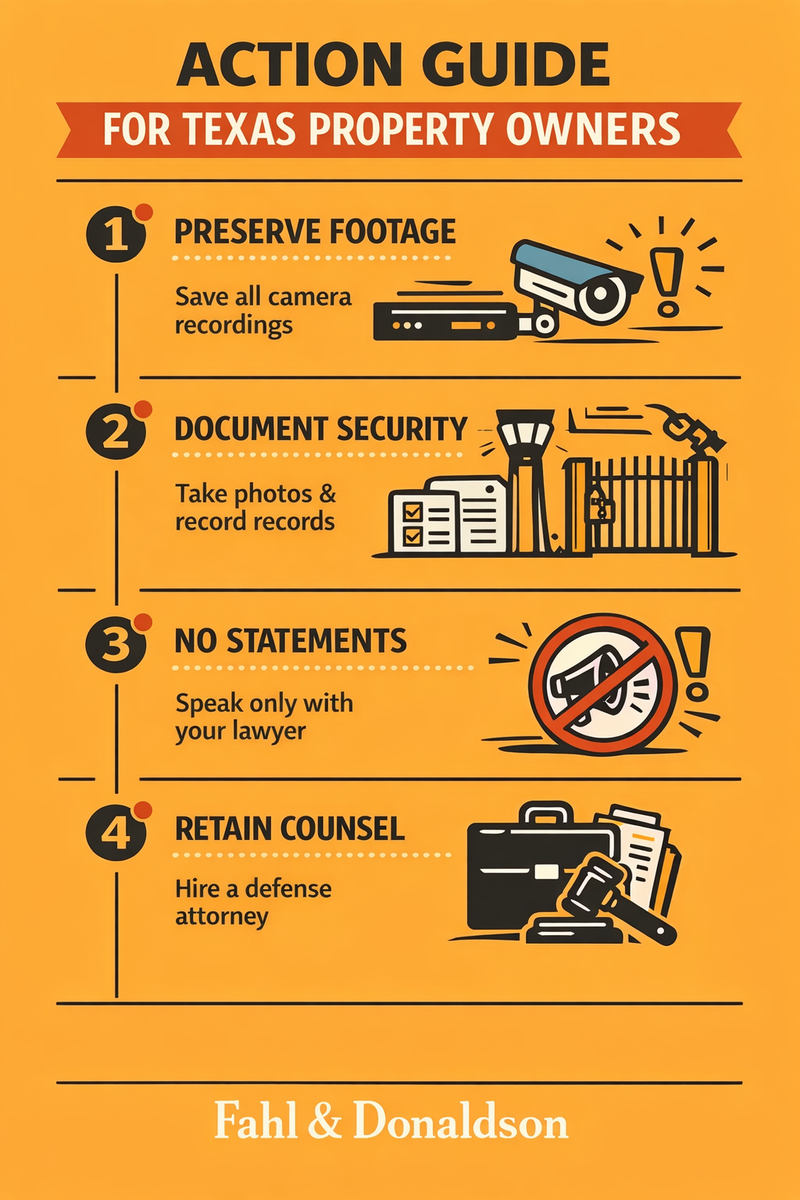
The steps most likely to protect your position include:
- Preserve all surveillance footage from the day of and the weeks prior to the incident, as footage is often overwritten on a rolling cycle
- Document the security measures that were in place at the time, including any lighting, fencing, gate systems, or security personnel logs
- Avoid making statements to plaintiff representatives, investigators, or media without legal counsel present
- Retain experienced defense counsel before a formal lawsuit is filed if possible, particularly if you have already received a demand letter or notice of representation
Doing nothing while waiting for a lawsuit to arrive is the single most damaging choice a property owner can make. The preservation window closes quickly, and gaps in evidence are rarely resolved in the defense’s favor.
Defend Your Property With Fahl & Donaldson
Inadequate security claims against apartment complexes and commercial properties in Texas are a growing category of litigation, and the firms handling them on the plaintiff side are experienced and well-funded. Property owners and investment groups need defense counsel with equivalent depth and courtroom readiness.
Fahl & Donaldson has successfully defended businesses and property interests in Houston and across Texas in complex civil litigation, including high-stakes cases involving serious injury and death. Attorney Glenn J. Fahl has tried more than 75 cases to verdict, and the firm’s litigation team is prepared to engage at every stage of the process. If your property is facing an inadequate security claim or you want to understand your exposure after a violent incident, reach out to our team to get started.