

 When a commercial truck accident ends in a lawsuit, the question of fault is rarely simple. Multiple parties, the driver, the carrier, a shipper, a maintenance vendor, even another motorist, may have each contributed to what happened, and how a Texas jury allocates responsibility among them determines exactly how much a trucking company pays. For businesses on the defense side of these claims, understanding how Texas law structures fault analysis is not optional; it is the foundation of a sound litigation strategy.
At Fahl & Donaldson, we defend trucking companies and their insurers in serious commercial vehicle litigation across Texas. Our trucking accident defense attorneys have tried these cases in courtrooms throughout the state, and we know how to use Texas’s proportionate responsibility law to protect our clients’ interests at every stage of a claim.
 What Is Texas’s Comparative Negligence Rule?
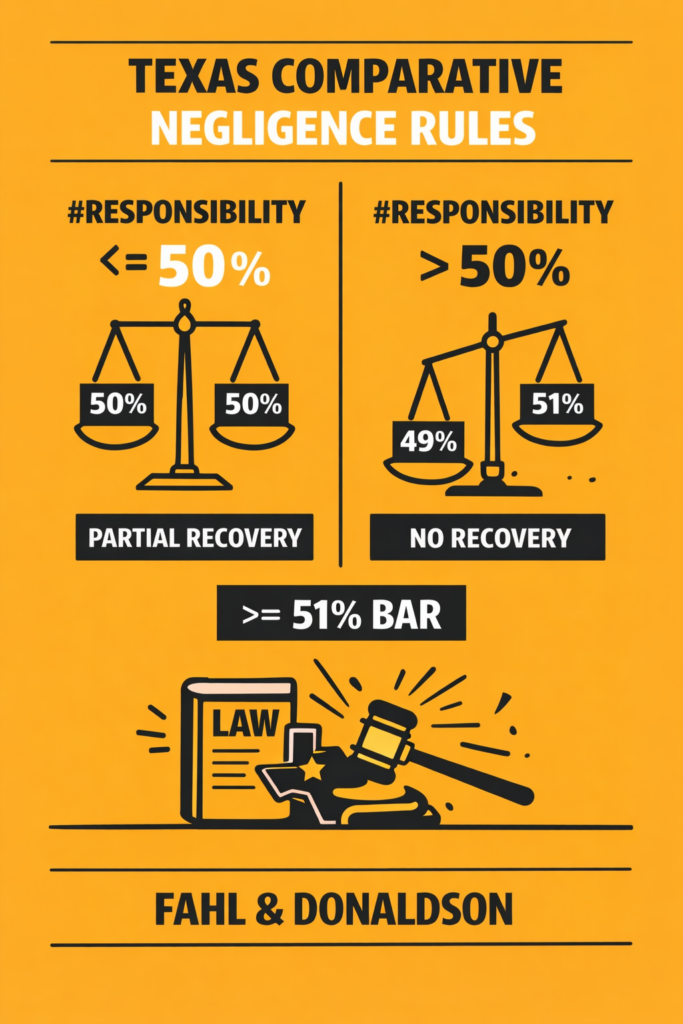
Texas follows a modified comparative negligence system, codified under Chapter 33 of the Texas Civil Practice and Remedies Code. The statute establishes what is commonly called the 51% bar rule: a claimant may not recover any damages if their percentage of responsibility is greater than 50%. If their fault is 50% or less, they can recover, but their award is reduced by their own percentage of fault.
For a trucking company facing a serious injury claim, this framework creates real opportunities. If the defense can demonstrate the plaintiff driver was speeding, failed to yield, or otherwise contributed meaningfully to the crash, every percentage point of fault assigned to the plaintiff reduces the carrier’s exposure. Push that number past 50%, and the plaintiff walks away with nothing.
How Does Fault Get Assigned in a Texas Trucking Case?
A jury decides fault allocation in cases that go to trial, working through the evidence presented by both sides to assign percentages of responsibility to each party. In commercial trucking cases, that analysis often involves several defendants at once, each with their own attorneys and their own interest in shifting blame elsewhere.
Who Can Be Named as a Responsible Party?
Texas law allows the jury to consider the fault of any responsible third party, not just the named defendants. In a trucking accident, that list can grow quickly and may include:
- The truck driver
- The motor carrier
- A freight broker
- A cargo shipper or loader
- A vehicle maintenance contractor
- A government entity responsible for road conditions
Defense counsel must understand this landscape early and use it strategically, identifying third parties whose fault can be allocated, which reduces the carrier’s proportionate share of liability.
What Defense Strategies Work Best Under This Framework?
The 51% bar creates a clear strategic target for defense attorneys: build a record that attributes a majority of fault to the plaintiff. That work begins at the scene of the accident and continues through discovery, expert analysis, and trial preparation. Our attorneys regularly review what defenses Texas businesses can use against truck accident lawsuits and tailor our approach to the specific facts of each case.
Evidence that tends to shift fault toward the plaintiff includes proof the other driver was speeding, following too closely, driving distracted, or failed to maintain their lane. In cases involving serious injuries, plaintiff attorneys will work hard to keep that fault percentage low, which means the defense must be equally aggressive in presenting a complete picture of what actually happened.
How Do Pre-Accident Records Factor In?
A carrier’s documentation before an accident shapes what a defense team has to work with after one. Driver qualification files, hours-of-service logs, maintenance records, and inspection reports all become evidence in litigation. When those records are thorough and compliant with FMCSA regulations, they give the defense strong ground to stand on. When they have gaps, plaintiff attorneys fill them with unfavorable inferences. Reviewing Texas trucking accident statistics alongside your own safety data helps carriers identify where their compliance programs need attention before a claim arises.
Does Comparative Negligence Apply When Multiple Defendants Are Involved?
Yes, and in multi-party Texas transportation accident cases, the interaction between multiple defendants is one of the most important dynamics to manage. Under Texas law, each defendant is generally liable only for their own percentage of responsibility, not the full award.
There is an exception for defendants found more than 50% at fault, who can be held jointly and severally liable for the entire judgment. That exception makes it critically important for carriers to present evidence that distributes fault broadly across all responsible parties rather than allowing it to concentrate on a single defendant.
Fahl & Donaldson Defends Texas Carriers in Trucking Litigation
Proportionate responsibility law gives trucking companies a meaningful path to reduced liability or complete defense verdicts, but only when it is deployed effectively. Fahl & Donaldson brings more than 100 years of combined litigation experience to every case, and our attorneys have tried trucking and transportation cases to verdict across Texas. Glenn J. Fahl has tried more than 75 cases to verdict, and we are built to fight when a strong defense is the right answer for our clients.
If your company is facing a trucking accident claim in Texas, do not wait to get experienced defense counsel involved. Reach out to Glenn J. Fahl and our team today through our contact form to discuss your defense options. The sooner you have qualified counsel reviewing the evidence, the stronger your position will be.