

A restaurant sells a round of margaritas to-go through a delivery app, a customer receives them at home, and hours later, there is an alcohol-related accident. The question that follows, who bears legal responsibility, is one that Texas businesses can no longer afford to leave unanswered. As third-party alcohol delivery has grown into standard practice across the state, so has the complexity surrounding dram shop liability and where it ultimately lands.
At Fahl & Donaldson, our attorneys work with Texas establishments navigating exactly these types of claims. With more than 100 years of combined litigation experience, we understand how shifting laws and business practices can create unexpected legal exposure for bars, restaurants, and other alcohol-serving businesses, and we know how to build a strong defense.
How Texas Law Approaches Third-Party Alcohol Delivery
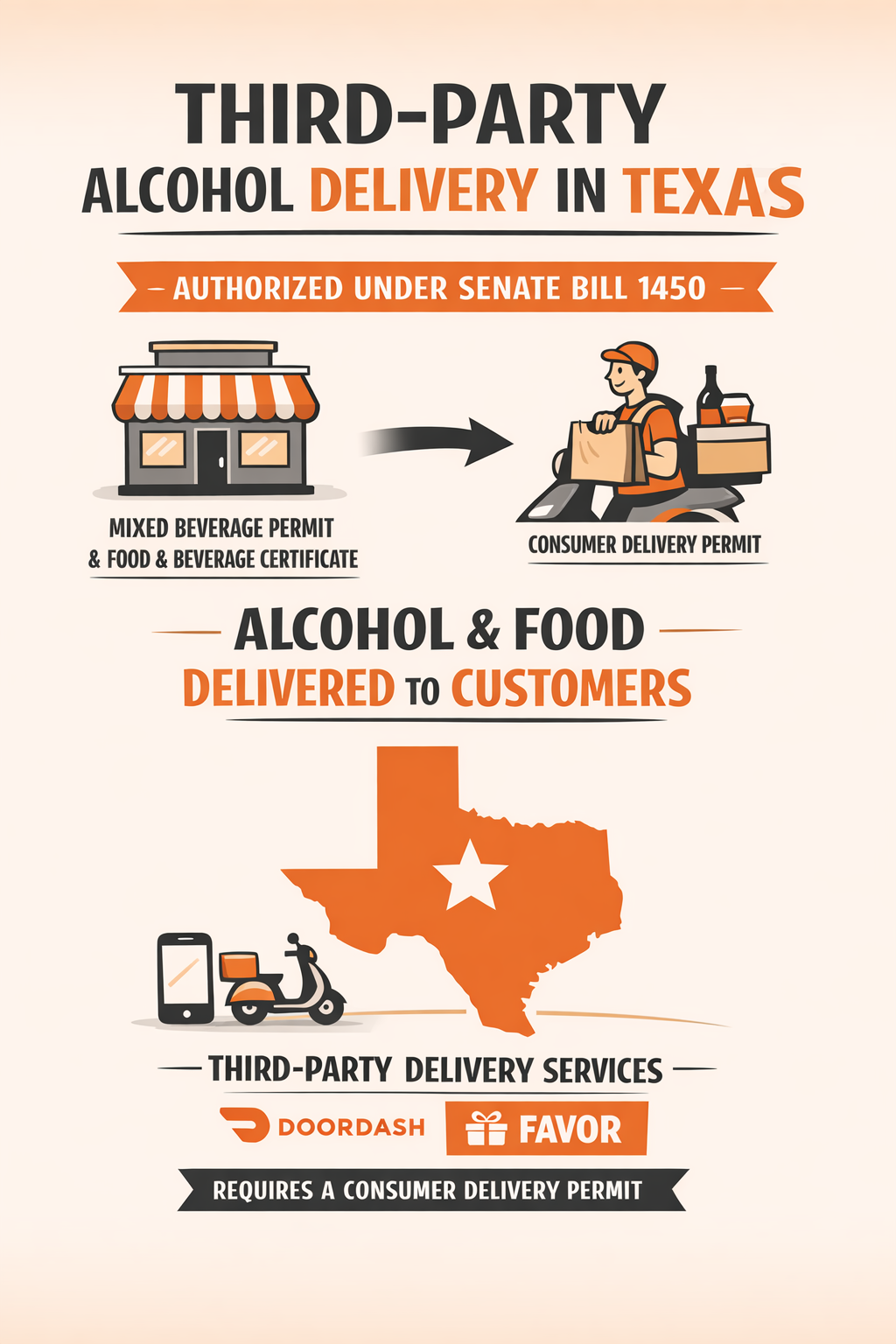
Texas authorized third-party alcohol delivery through Senate Bill 1450, with permanent rules later cemented into law. Under this framework, businesses holding a Mixed Beverage Permit with a Food and Beverage Certificate may use third-party contractors holding a Consumer Delivery Permit to deliver alcohol alongside food orders to customers. According to the Texas Alcoholic Beverage Commission, services like DoorDash and Favor fall into this category when they hold the required permit.
This system divided responsibility significantly. Under the Texas Alcoholic Beverage Code, a retailer’s obligations are considered satisfied once it transfers possession of the alcoholic beverage to a Consumer Delivery Permit holder or a delivery driver acting as that permittee’s agent. Once the handoff occurs and the third party takes over, the original establishment may no longer be responsible for what happens next, but only when the rules were followed at the point of sale.
When the Shield Holds and When It Does Not
The liability transfer is not automatic. If a bar serves alcohol to a customer who was visibly intoxicated before that order was even packaged for delivery, the retailer’s responsibility does not simply disappear because a third party completed the transaction. Texas dram shop liability defense cases often hinge on exactly this point, the moment of service and what the establishment knew or should have known at that time.
There is also the question of whether the correct permits were in place. A business that uses a third-party delivery service whose driver does not hold a valid Consumer Delivery Permit cannot rely on the transfer-of-responsibility framework. In those situations, shared or full liability for the original establishment becomes a real possibility.
The Safe Harbor Defense and Third-Party Delivery
Texas law includes a safe harbor provision that, when properly utilized, may protect an establishment from dram shop liability. To qualify, the following conditions must be met:
- Mandatory training: The employer must require employees to complete an approved alcohol safety awareness program.
- Actual completion: The specific employee involved must have actually attended and completed the training.
- No encouragement of violations: The employer cannot have directly or indirectly encouraged any violation of the law.
When these conditions are satisfied, a business has a meaningful foundation for defending against a claim. A restaurant or bar that failed to train its own staff on proper service practices before an order left the premises will find little shelter in the safe harbor, regardless of what happened during delivery.
Shared Liability Scenarios Worth Understanding
One scenario that generates significant legal complexity is when a customer is already intoxicated at the time of an in-person visit, places a to-go order with alcohol, and then drives away and causes harm. Plaintiffs may argue that the establishment served a visibly impaired person and that the alcohol contributed to the accident, making the delivery element almost irrelevant to the dram shop analysis. Understanding who can file a Texas dram shop claim helps businesses appreciate how broad the exposure can be.
Texas law is also unambiguous when it comes to minors. Alcohol may not be delivered to anyone under 21, and the delivery driver must verify identity and age upon delivery. If a third-party driver fails to do so, liability may attach to the Consumer Delivery Permit holder. If the original establishment had reason to know the order was intended for a minor, it too may face exposure.
Defending Your Business Against a Dram Shop Claim
When a claim arises, the evidence gathered in the days immediately following an incident is often decisive. Security footage showing the customer’s condition at the point of sale, delivery records, driver certifications, employee training documentation, and sales receipts all carry weight. The comparative negligence framework in Texas also matters. Courts look at the conduct of all parties and apportion fault accordingly, so strong business litigation representation can make a meaningful difference in the outcome.
Establishments that maintain detailed records and invest in TABC-compliant training programs are in a far better position to defend against claims than those that do not. A skilled defense attorney will work to place responsibility where it actually belongs and challenge any overreach in how liability is assigned.
Fahl & Donaldson Is Ready to Defend Your Texas Business
The intersection of alcohol delivery, third-party permits, and dram shop liability represents one of the more complex areas of Texas business law, and it is one our firm handles with a depth of knowledge that comes from decades of courtroom experience. Glenn J. Fahl has tried more than 75 cases to verdict, and R. Kelly Donaldson has successfully arbitrated and litigated over 30 complex cases.
If your establishment is facing a dram shop claim or you want to understand your exposure before a claim arises, do not wait. Reach out to our team through our contact form to schedule a consultation today.